


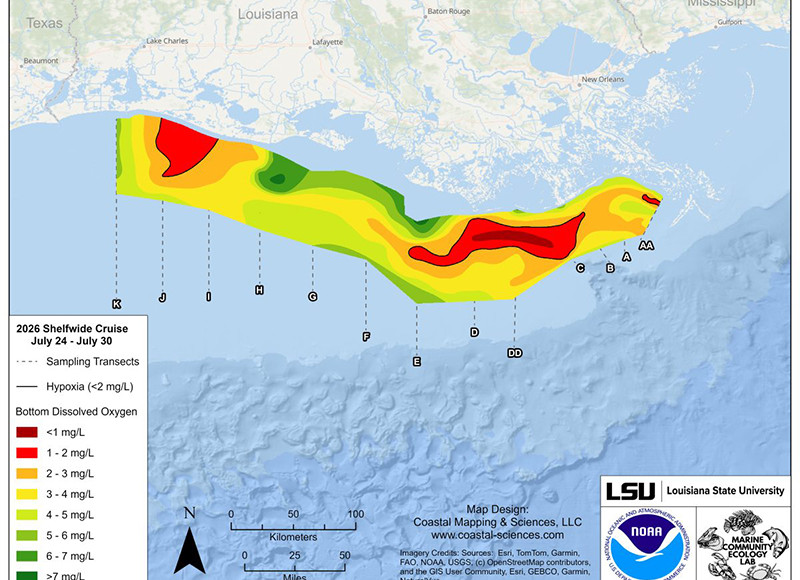
The recent mapping of the “Dead Zone” in the northern Gulf of Mexico in late July through early August 2026 estimated an area of 1,332 square miles (3,449 square kilometers) of the bottom of the Continental Shelf off Louisiana and Texas.
The dead zone — or hypoxic zone — occurs when a water mass with oxygen concentrations less than 2 parts per million forms in bottom waters primarily because of nitrogen loading from the Mississippi River watershed, which fertilizes the Gulf of Mexico’s surface waters to create excessive amounts of algal biomass. The decomposition of this plant material in the bottom layer and sediments leads to oxygen loss. The low oxygen conditions in the Gulf of Mexico’s most productive waters can stress organisms and may even cause their death, threatening living resources, including fish, shrimp and crabs caught there.
The annual hypoxic zone survey was led by scientists at Louisiana State University and the Louisiana Universities Marine Consortium (LUMCON) aboard the LUMCON research vessel Pelican from July 24-30.
While the prediction in May 2026 was that the size would be larger than average, the lack of river discharge for the remainder of the month through the time of the mapping was below average. In addition, Tropical Storm Bertha (track pictured here) formed over 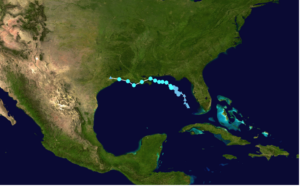 Panama City, Florida, on July 19 in the northeastern Gulf of Mexico and followed an unusual westward path through July 24 along the northern Gulf coast, making two landfalls in Louisiana before weakening over Texas.
The 2026 mid-summer size of the annual Gulf dead zone is the third smallest since mapping began in 1985. While the 2026 size falls near the Hypoxia Action Plan goal, it is only one year of many since the Plan was adopted in 2001 and represents physical mixing of the water column.
Low oxygen conditions which occur annually began to appear 55 years ago when agricultural practices intensified in the U.S. Midwest. No significant reductions in the nitrate loading from the Mississippi River to the Gulf of Mexico has occurred since the Hypoxia Action Plan was adopted in 2001.
- Click here for the full report