

GCOOS is developing a new acoustic database for Rice’s whales, one of the world’s rarest and most endangered cetacean species. This newly recognized species of baleen whale is estimated to have a population of only about 100 individuals in the northeastern Gulf and faces severe threats from vessel strikes, noise, pollution and fishing gear. Working with the University of South Florida and NOAA on a project funded by Florida RESTORE, GCOOS is developing an AI classifier — nicknamed GUARDIAN — that can integrate acoustic data from moored, shipboard and unmanned oceanographic systems to systematically monitor and analyze ecosystem level distribution and ecology of the critically endangered whales. The deep learning toolkit detects Rice’s whale vocalizations — processing terabytes of ocean audio that no human team could review.
For example, we ingested data from a recovered 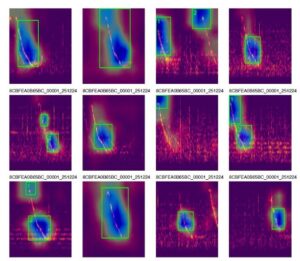 Teledyne Webb Research Slocum glider equipped with Loggerhead Instruments passive acoustic recorders from a multi-month deployment in possible Rice’s whale habitat. Within hours of receiving the data, the GUARDIAN audio processing toolkit and AI classifier had processed more than 8,000 acoustic files and identified more than 200 potential Rice’s whale vocalizations in one day with an average confidence of 96%.
More recently glider M162, deployed Nov. 15 to Jan. 8, detected Rice’s whale acoustic signatures 3,094 times. The peak was on Dec. 26, with 220 detections.
There’s a clear pattern emerging: detection counts jumped dramatically around Dec. 14 and stayed elevated through early January, with the late December period (Dec. 21-30) being especially active. The first half of the deployment (Nov. 15-Dec. 13) averaged about six detections per day, while the second half averaged roughly 120 per day.
The GUARDIAN toolkit uses deep learning with GradCAM visualization overlays to not only detect marine mammal vocalizations but show researchers exactly what acoustic features the model is responding to. This transparency is critical for scientific validation and for identifying the small number of false positives we need to train out of future model versions.
The AI classifier being developed by GCOOS will also be trained to recognize other cetacean and fish species.