

Report is designed to help communities understand and plan for future heatwaves in the region
The world’s oceans are getting hotter — global sea surface temperatures and heat in the upper ocean reached historical records in 2024. Warming trends are continuing in 2025 on sea and on land, with the U.S. experiencing above-average temperatures this summer — including a prolonged heat dome settling across much of the U.S. in July and record-high temperatures in Florida and the Mid-Atlantic, Northeast and Great Lakes regions. Just last week, the first named hurricane of the Atlantic season shot from a Category 1 storm to a 5 in just 24 hours as it fed on warm Atlantic waters.
Warmer ocean temperatures can mean more frequent and more intense hurricanes, but that’s just one impact. Marine heatwaves (MHW) — warmer than normal water temperatures over an extended period — can impact fisheries, coral reefs, energy production and even inland temperatures for coastal communities.
GCOOS has released a new report: “Gulf and Caribbean Marine Heatwave Impacts,” which discusses various potential impacts of marine heatwaves in the 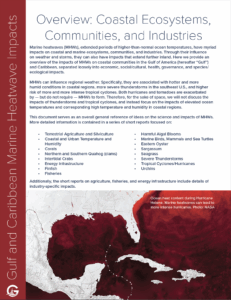 Gulf and Caribbean region. It includes a broad overview of expected impacts from marine heatwaves, along with a series of short reports focused on impacts to individual species — like oysters and finfish — and economic sectors — like energy and fisheries.
- The report is available in both English and Spanish.
Based in the Department of Oceanography at Texas A&M University, the Gulf of America Coastal Ocean Observing System (GCOOS) is the regional component of the nation’s Integrated Ocean Observing System (IOOS) and is responsible for developing a public-private-academic network that collects and combines data to provide timely information about our oceans — similar to the information gathered by the National Weather Service to develop weather forecasts. For 20 years, GCOOS has been providing this accurate and reliable information to support coastal communities and the Gulf’s blue economy.
The new report — developed by Dr. Renata Poulton Kamakura, National Academies Gulf Research Program Science Policy Fellow with GCOOS (2024-2025), and Dr. Chris Simoniello, GCOOS Outreach and Education Manager — review current scientific data and information, compiling known heatwave impacts on sectors and species, as well as information on data gaps. The report gives communities information to better prepare and respond to marine heatwaves, which are expected to increase in frequency and intensity in the coming years.
“Marine heatwaves — which have made headlines along the U.S. West Coast and globally over the last decade — are a growing phenomenon in the Gulf of America and Caribbean and they are likely to become more frequent and more intense in the coming decades,” said Poulton Kamakura. “Not only do marine heatwaves impact species living in the ocean, but also our coastal communities and the people who rely on coastal resources for their livelihoods and recreation. At GCOOS, we wanted to provide an overview of what has been studied — and what we still don’t know — about marine heatwave impacts to help our communities prepare for the next marine heatwave, especially if it takes place during hurricane season. While there is still much to be learned, we hope this report gives regional researchers, managers and planners a solid start for future research, mitigation and adaptation efforts.”
The report is part of a larger project GCOOS began with researchers at the University of South Alabama/Dauphin Island Sea Lab (DISL) in 2024 to develop a framework for expected marine heatwave impacts, as well as a heatwave alert system. The project is helping to define the tools needed for better detection of marine heatwaves — both at the surface and in the water column — so that Gulf stakeholders and resource managers can mitigate impacts on coastal communities, ecosystems and industries.
“Over the last 20 years, GCOOS has been at the forefront of gathering and disseminating the data and information that Gulf Coast communities need to protect jobs and residents from variability in things like ocean conditions,” said Simoniello. “Our focus on marine heatwaves is just one more way that GCOOS is responding to communities’ needs for ocean information that keeps them safe and their jobs secure.”
- “Gulf and Caribbean Marine Heatwave Impacts” is available in both English and Spanish in a downloadable PDF format both as a full report and as individual reports focused on specific topics. Click here for more