

GCAN has awarded five travel grants to outstanding students from the Gulf region to attend the 2026 NOAA Ocean Acidification Program Community Research Meeting May 4–6 at the NOAA Center for Weather and Climate Prediction in College Park, Maryland. The 2026 OAP Research Community Meeting unites investigators and partners to examine the trajectory of ocean change and serves as an opportunity for sharing insights, aligning research goals and refining strategies for ocean resilience. At the meeting, awardees will share their research, build connections and participate in the GCAN workshop “Translating Ocean and Coastal Acidification Science for Different Audiences,” facilitated by Drs. Natalia López-Figueroa, Xinping Hu and Emily Hall. These emerging scholars will help shape the future of ocean acidification research in the Gulf of America and are already making a strong impact through their graduate work. Congratulations to the awardees!
Florida: Macarena Martín Mayor, Ph.D. Candidate
Macarena Martin-Mayor is a Ph.D. Candidate at the University of South Florida College of Marine Science. Originally from Spain, Macarena received a bachelor’s degree from King University, Tennessee, with double major in Biochemistry and Mathematics, graduating with honors. She is a student in Dr. Bob Byrne’s CO2 chemistry lab and her research focuses on refining the carbonate system constants K2 and KB through new spectrophotometric methods, leading to more accurate measurements and models, and their application in the first comprehensive ocean acidification assessment of the Gulf of America. Macarena is a leader in her community, serving various committees that range from student representative of her department to university-level committees. She has also served as the pH technician in the GOMECC series engaging in sample collection, processing and data quality control.
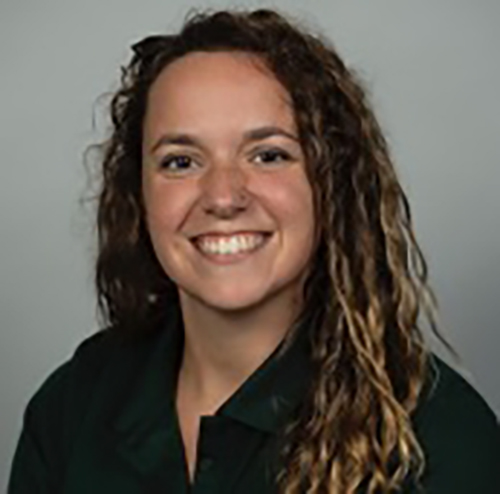
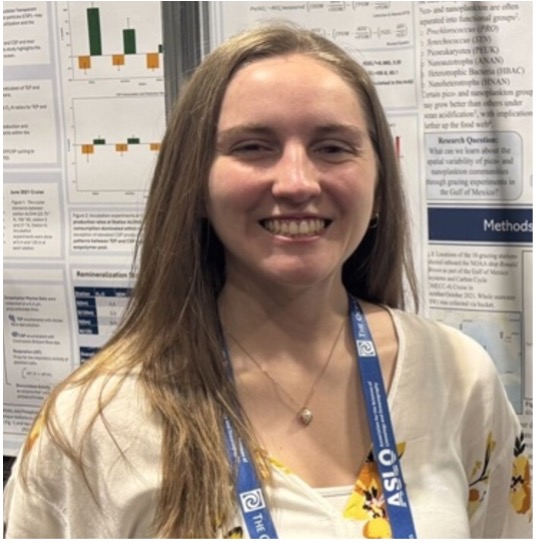
Louisiana: Emily Mulcahy, M.Sc. student
Emily Mulcahy is a second-year master’s student in biology at the University of Louisiana at Lafayette (ULL). She completed her BSc. in Biological Sciences with a focus in Ecology, Evolution, and Behavior at Virginia Tech, where she also minored in Wetland Science and Green Engineering. Emily’s undergraduate research at Virginia Tech focused on whole ecosystem metabolism in isolated wetlands; however, her interests in phytoplankton and biological oceanography led her to the Stauffer Lab at ULL.
Emily’s thesis explores how predator-prey interactions and ocean acidification, along with other environmental parameters, impact pico- and nanoplankton functional group dynamics across the Gulf. Emily is honored to be chosen as the Louisiana fellow and representative of the GCAN award and is thrilled to present her master’s work at the Ocean Acidification Program Research Community Meeting.
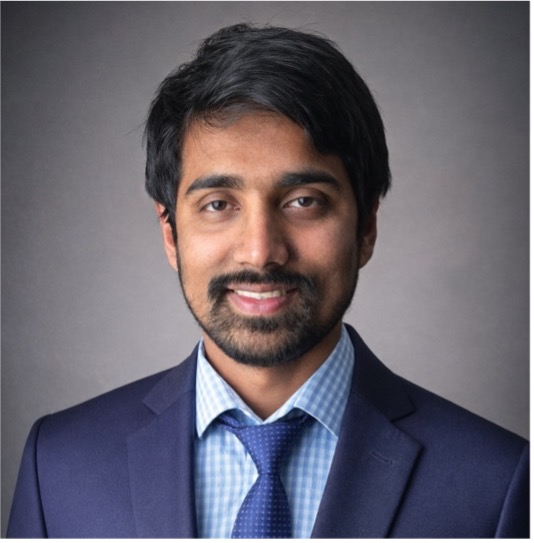
Mississippi: Hafez Ahmad, Ph.D. candidate
Hafez is currently enrolled in the Department of Earth and Atmospheric Sciences at Mississippi State University. He holds a Master’s degree in Wildlife, Fisheries, and Aquaculture from Mississippi State University and a Bachelor’s in Oceanography from the University of Chittagong, Bangladesh. His research focuses on coastal and estuarine water quality, remote sensing, machine learning, and environmental data science, with particular emphasis on chlorophyll-a dynamics, hypoxia, phytoplankton ecology, and ecosystem monitoring. His work integrates satellite remote sensing, field observations, geospatial analysis, and advanced modeling to better understand environmental change in the Gulf of America and other coastal systems. He has contributed to multiple research publications and presentations in the areas of water quality, remote sensing, and aquatic ecosystem science.
Teas: Lauren Bomer, Ph.D. Student
Lauren is a second-year Ph.D. student at the University of Texas Marine Science Institute in Port Aransas. Her dissertation research focuses on pteropod community dynamics in the Gulf, examining how these pelagic calcifiers respond to changing environmental conditions. Using carbonate chemistry analysis, morphological measurements, and stable isotope techniques, Lauren is currently working to understand the environmental thresholds that affect pteropod shell health and distribution across estuarine to offshore gradients.
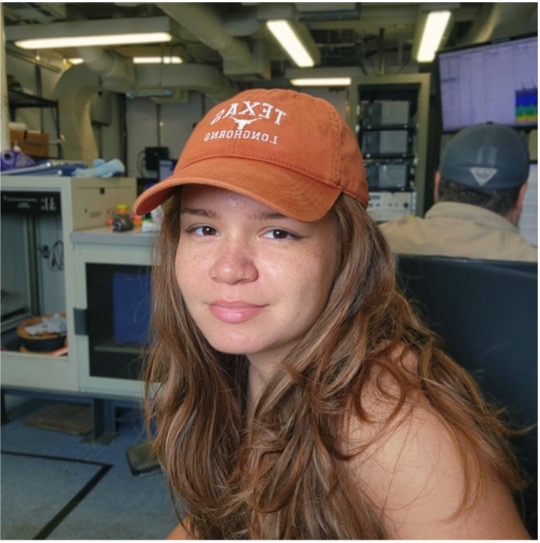
Texas: Alyssa Antolak, Ph.D. Candidate
Alyssa is a third-year Ph.D. candidate in the Marine Biology program at Texas A&M University at Galveston, under the advisement of Dr. Antonietta Quigg. Her research focuses on how phytoplankton community composition influences the formation of marine snow under both natural and anthropogenic stressors. Marine snow plays a critical role in global carbon cycling, serving as a primary pathway for transporting carbon from surface waters to the deep ocean.