

The Gulf of America AUV Network, Data Archive and Layer Fusing piloting portal — known as GANDALF — has completed a landmark year of ocean exploration and environmental monitoring, orchestrating 39 autonomous underwater vehicle deployments across the Gulf of America, Caribbean and Atlantic coastal waters during 2025. These missions collectively accumulated 2,324 days at sea — that’s more than six years of continuous ocean observation compressed into a single calendar year.
The GANDALF portal, developed by GCOOS, provides real-time piloting support, data visualization and data management services for autonomous vehicle operations. Mission data is automatically processed and submitted to the IOOS Glider Data Assembly Center, ensuring that observations from diverse operators contribute to national forecasting models and the broader oceanographic community. GANDALF services are provided at no cost to operators and are particularly valuable to institutions with limited IT support resources.
The 2025 deployment season showcased unprecedented collaboration among 11 leading oceanographic institutions, including the Atlantic Oceanographic and Meteorological Laboratory (NOAA/AOML), Centro de Investigación Científica y de Educación Superior de Ensenada (CICESE-Mexico), University of South Florida, Texas A&M University, Mote Marine Laboratory, Skidaway Institute of Oceanography, the U.S. Navy, Rutgers University, and the Caribbean Coastal Ocean Observing System (CARICOOS). It included a fleet of 29 individual underwater vehicles across multiple technology platforms:
- Slocum Gliders (all three generations): 22 deployments
- Seagliders: 13 deployments
- SeaScout AUV: 4 deployments
These vehicles ranged from compact coastal survey platforms to long-endurance oceanographic missions, with the longest single deployment of TAMU’s Unit_1148 lasting an impressive 166 days on hurricane monitoring duty.
“Deployments represent the democratization of ocean observation technology,” says GCOOS Product Developer Bob Currier, who created GANDALF. “By providing a unified platform for managing diverse autonomous systems, we’re enabling institutions of all sizes to contribute to our understanding of critical ocean processes.”
Advancing Marine Science Across Multiple Fronts
A major focus of 2025 operations was hurricane prediction and monitoring, with eight dedicated hurricane-related deployments accumulating 796 days of critical observations. These missions positioned autonomous gliders directly in the paths of developing storm systems, collecting real-time data on ocean heat content, salinity structures and current patterns — information essential for improving hurricane intensity forecasts.
The Navy Hurricane Gliders program deployed three vehicles for 150 consecutive days each, maintaining persistent presence in key hurricane formation regions. Additional hurricane monitoring efforts came from SECOORA (Southeast Coastal Ocean Observing Regional Association), Texas A&M’s Geochemical and Environmental Research Group, and the University of Southern Mississippi’s picket line operations.
Beyond hurricane research, 2025 GANDALF operations supported several other oceanographic initiatives:
- Red Tide Monitoring: University of South Florida and Mote Marine Laboratory deployed vehicles equipped with optical sensors to track harmful algal blooms along Florida’s coastal ecosystems.
GANDALF 2025 At-a-Glance
- 39 autonomous vehicle deployments
- 2,324 cumulative days at sea
- 29 individual vehicles operated
- 11 participating institutions
- 62 days average deployment length
- 21 distinct research projects supported
- Year-round operations: First deployment launched Jan. 19; final recovery Dec. 5
- Gulf Circulation Studies: CICESE’s extensive deployment program (seven missions under APIXQUI/SECIHTI and GRASE-UGOS3-GulfCORES projects) provided unprecedented observations of Gulf circulation patterns and cross-shelf exchange processes.
- Right Whale Conservation: Specialized acoustic monitoring deployments off the Southeast U.S. coast tracked critically endangered North Atlantic right whales, providing data crucial for protecting shipping lanes and reducing vessel strikes.
- International Ocean Observatories: GCOOS and SECOORA maintained persistent coastal monitoring networks, with 11 combined deployments providing continuous environmental baselines.
- Caribbean Ocean Health: CARICOOS deployed Seagliders around Puerto Rico, monitoring ocean conditions vital to Caribbean marine ecosystems and coastal communities.
The success of 2025 operations positions GANDALF as a cornerstone of U.S. ocean observing infrastructure. With proven capabilities in multi-institutional coordination, real-time operations, and diverse mission support, the platform is poised to expand its role in addressing critical ocean science challenges—from climate change impacts to marine ecosystem health, from extreme weather forecasting to maritime domain awareness.
As autonomous ocean technology continues advancing, GANDALF stands ready to orchestrate next-generation of ocean observation tools, turning individual vehicles into a coordinated network of ocean sentinels working 24/7 to unlock the ocean’s secrets.

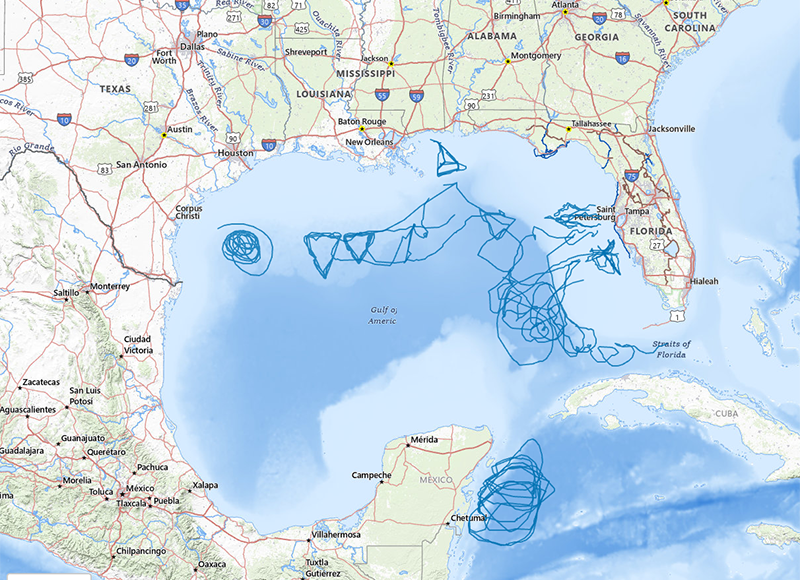
2025 glider missions included deployments in both the U.S. and Mexican Gulf designed to sample the precursor of the Yucatan and Loop currents to increase understanding of Eddy detachments. This glider was deployed by CICESE in the Caribbean.